The Real Cost of Sales Without a System
Selling in B2B today is genuinely harder than it was five years ago. McKinsey's 2026 Global B2B Pulse Survey, drawing on nearly 4,000 B2B decision-makers across 13 countries and multiple industries, gives some context to why: buyers now interact across an average of ten channels before making a purchasing decision, and they have less time and less mental focus to evaluate than they did before. This report focuses on e-commerce, but in SaaS & Tech B2B environments, this friction is even more counterproductive, because the solution is complex and the buying committee is crowded.
The natural response to that pressure is to look for something that helps, and the market for AI-first sales tools moves so fast that not keeping up feels like falling behind. Every quarter there is something new that promises to close the gap: a smarter prospecting tool, a sequencing platform with AI-generated messaging, an automation layer that was not possible twelve months ago. The temptation to adopt is genuine, and in many cases the tools themselves are excellent, however, what gets lost in the process is the question of whether all of these moving parts are pointing in the same direction.
What the Tools Cannot Solve
In my experience as a sales professional, I can confirm that the individual tools are usually fine: the tech stack is modern and the sales materials are polished. I consistently had product sheets, a LinkedIn profile, automated email sequences, and a structured CRM pipeline at my disposal. Each was doing exactly what it was meant to do, but somewhere between all of those assets and actual revenue, there was an overlooked mismatch.
What I actually had was a set of tools and materials that had each been built with a slightly different buyer and sales objective in mind: A product sheet designed for one type of sales conversation, a LinkedIn strategy aimed at a different audience, and an email campaign running with messaging written for an entirely different account tier. They were all coherent individually, but not particularly aware of each other, and from where I stood, as the person responsible for making something happen at the end of the sales chain, it took me a while to realize that what was missing was not another tool or marketing asset, but a cohesive commercial system behind all of them.
What the Data Confirms
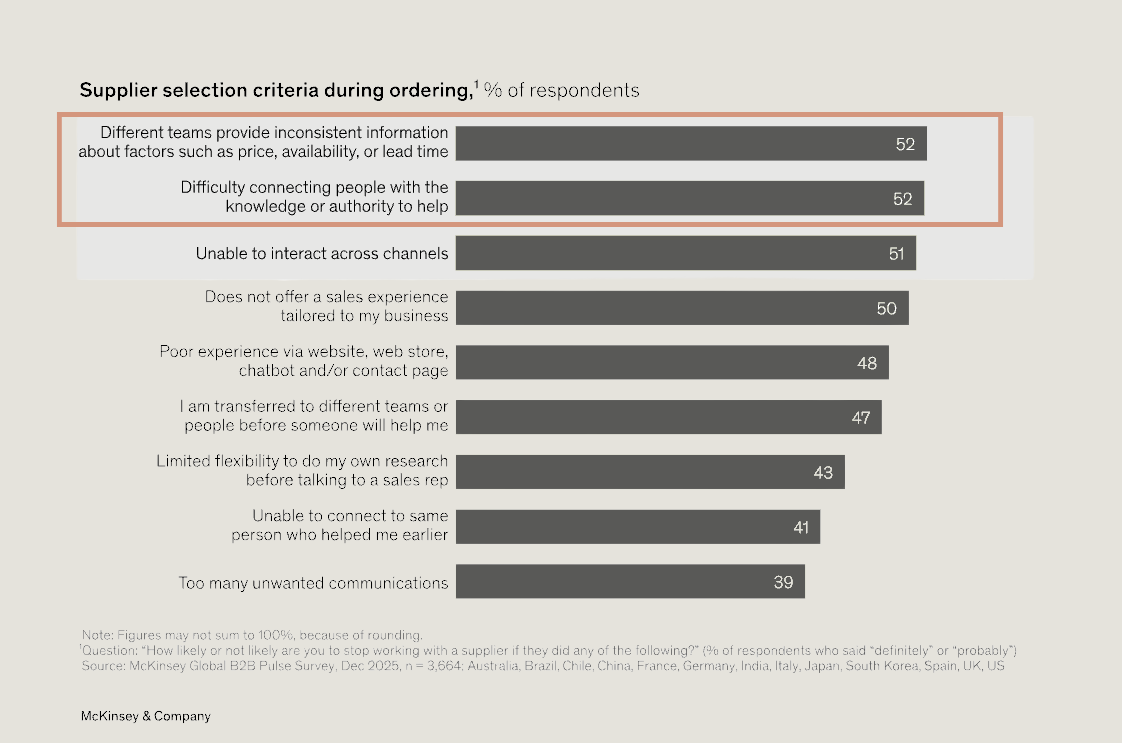
McKinsey’s data suggests this problem is more common than many assume, with buyers cite inconsistent information across teams as the top reason for switching suppliers, followed by the inability to access knowledgeable representatives.

A System, Not a Collection
After fifteen years working across the full sales cycle (from qualification logic to closing to account management), I know that a tool only creates value when it fits into a coherent structure. We all know that, but knowing it does not seem to make it any easier to act on.
It is not quite the same as ancient Greek statues. They are almost always incomplete, with missing parts, yet they remain beautiful in their incompleteness. A commercial system does not have that luxury: nobody will cry for its beauty if the pipeline does not move.
Of course, most commercial systems are far from beautiful, and reality will always introduce friction and force adaptations. That is expected. What I have observed more often than thought, however, is that shopping for sales tools or running sales activities without first investing in a commercial system does not just slow results over time. It creates visible damage in the short term, too.
B2B Sales Costs: The Visible Part
When a company decides it is time to formalize its sales operations, the initial investment generally follows a recognizable pattern:
A contact database license to identify decision-makers is purchased (somewhere between €100 and €150+ per user/month),
A sequencing platform for automated outreach (€40 to €100+),
A CRM to track pipeline progression (€20 - €50+),
A dedicated sending domain and a warming service to make sure the emails actually land (€60 - €120+),
An AI-first tool for messaging and research (€50 - €100+),
And a sales professional to operate all of it.
You end up very quickly somewhere between €4,300 and €5,500+ a month, depending on the choices made along the way.
B2B Sales Costs: What the Budget Does Not Show
The hidden cost, the hours of management spent supervising, correcting direction, and participating directly in sales activities never appears in any budget line, but it accumulates with remarkable consistency.
Despite that budget allocation, results rarely follow, because that budget was never designed to cover a defined ICP, a validated message, a qualified pipeline, or answer the fundamental questions at the core of your go-to-market strategy.
Building a commercial system requires a type of focus that is genuinely difficult to find inside a company managing many other priorities. The decisions that make a sales function work (who to target, how to reach them, what to say, and how to know if it is working) are not decisions that can be made well in between everything else. They require someone whose entire professional attention is dedicated to that problem.
This is why bringing in a specialized sales freelancer or fractional sales expert is a strategic move worth considering.
Getting that commercial foundation right before adding headcount or additional tools is not a guarantee of success, of course, but it makes the difference between building assets that are connected to each other and investing in tools that are each pointing in a slightly different direction.