“We need five new clients” is a clear commercial objective if the number is linked to a thoughtful business plan, but it tells you very little about the work needed to get there.
Does the company already have a defined customer profile and an offer that is understood by buyers? Are the sales materials useful in real conversations? How much research does each account require? And who has the time to do the work consistently?
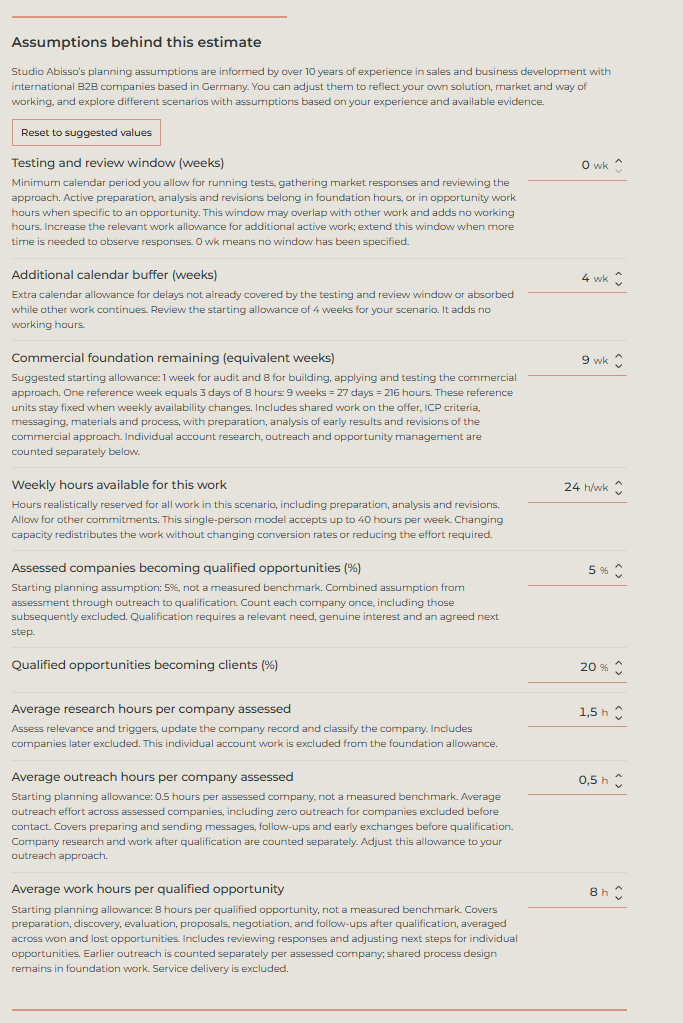
I created the Studio Abisso Commercial Workload Calculator to make those questions easier to explore. The calculator turns a client target and a set of editable assumptions into an estimate of the working hours, and the calendar capacity, needed to deliver them.
Commercial Workload Calculator
The calculator turns a client target and a set of editable assumptions into an estimate of the working hours, and the calendar capacity, needed to deliver them.
The calculator estimates the work involved in outbound B2B sales, from building the commercial foundation to researching companies, reaching out and developing qualified opportunities. Inbound activities such as content, SEO and campaigns fall outside its scope.
What sits behind the client target
I group the work into three areas. The foundation serves the whole scenario, while research and sales activity depend on how many companies and opportunities you work with.
Commercial foundation
Build, apply and refine the offer, customer criteria, messaging, materials and sales process. This shared work is counted once and adjusted for work already completed.
Company research
Evaluate individual companies, check relevance & buying signals, and record what you learn.
Sales activity
Allow for outreach before qualification, then discovery, proposals, negotiation, and follow-ups afterwards. The calculator estimates these two workloads separately, including effort that does not lead to a client.
That distinction matters when the assumptions change. A lower qualification rate means more companies to research and approach. A higher client target adds acquisition work, while the shared foundation is counted once.
Putting the estimate in context
In the calculator’s starting scenario, a target of one new client corresponds to about 460 hours of commercial work.
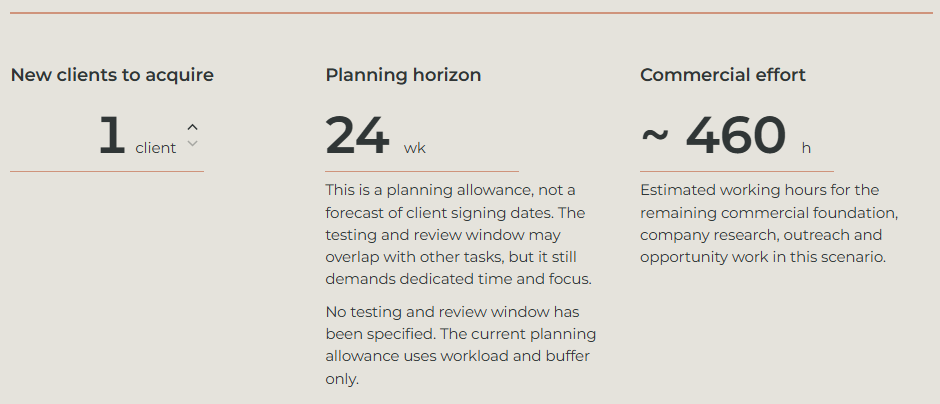
The example uses a 5% qualification rate and a 20% close rate. These assumptions translate a target of one new client into five qualified opportunities and 100 companies to assess.
In the calculator, try changing weekly availability from 24 to 16 hours. See how the planning horizon changes while the estimated effort stays the same.
Approximately 220 hours go towards the remaining foundation work. The rest covers research, outreach and work on individual opportunities, including those that do not close. A company that has already completed much of the foundation can face a different workload for the same target.
The hours and the weeks tell different stories
At 24 hours per week, 460 hours of work round up to 20 weeks. Four additional weeks of buffer bring the planning horizon to 24 weeks.
Preparing tests, analysing responses and revising the approach take dedicated work. Gathering market feedback also takes calendar time. The activities can overlap, and the starting example leaves the testing and review window unspecified.
What the company keeps
The work behind the target can leave you with a clearer offer, better customer criteria, reusable materials, a sales process people can follow, usable CRM records and evidence about how the market responds. Those assets can support future opportunities, while each new company still needs its own research and outreach.
The estimate connects the result you want with the work someone needs to structure, execute and manage. That makes decisions about internal capacity and external support more concrete.
The calculator models outbound workload. A full customer acquisition cost analysis would also account for costs outside this estimate, including marketing. The model also leaves out detailed task dependencies, changing conversion rates, market saturation and service delivery.
If you’d like support structuring and managing your commercial activities, request a discovery call.